
What Do Americans Think They Owe Each Other?
A large-scale study of civic responsibility


Excerpts from this piece were published on January 7, 2026 in USA Today. You can read the full piece here.
Share. Wash your hands. Don’t push. Be kind.
These are the lessons I’ve tried to impart to my 3-year-old daughter (with mixed success). They’re simple rules of the road, meant to help her navigate the world and become a contributing member of any community she joins later in life.
They’re also universal: they apply to everyone regardless of their background or beliefs.
But there is another set of more specific expectations that applies to us as Americans: what we call “civic responsibilities.”
When Benjamin Franklin famously described our nation as “a republic, if you can keep it,” his point was not that the Founding Fathers had secured our future for us, but that they had entrusted it to us. The survival of the American experiment would depend on whether citizens could sustain the values, norms and behaviors that make self-government possible—what Alexis de Tocqueville called “habits of the heart.”
My collaborators and I at the Beacon Project wanted to know how Americans think about these civic habits, particularly as our country approaches its 250th anniversary. Do people generally agree about what we owe each other, or do they diverge along the usual fault lines?
Over the past year, we conducted a series of studies involving over 5,000 Americans to answer this question. What follows is a summary of our findings. (We also produced a website exploring the data CivicProfile.us, and an interactive quiz that allows you to see how your beliefs compare with other Americans. What’s your civic profile? Share your results in the comments!)
Study 1: In Their Own Words
In our first study, we recruited 199 Americans and simply asked them to describe in their own words what they think Americans are responsible for. This approach allowed us to measure Americans’ beliefs about civic responsibility without imposing a predetermined definition.
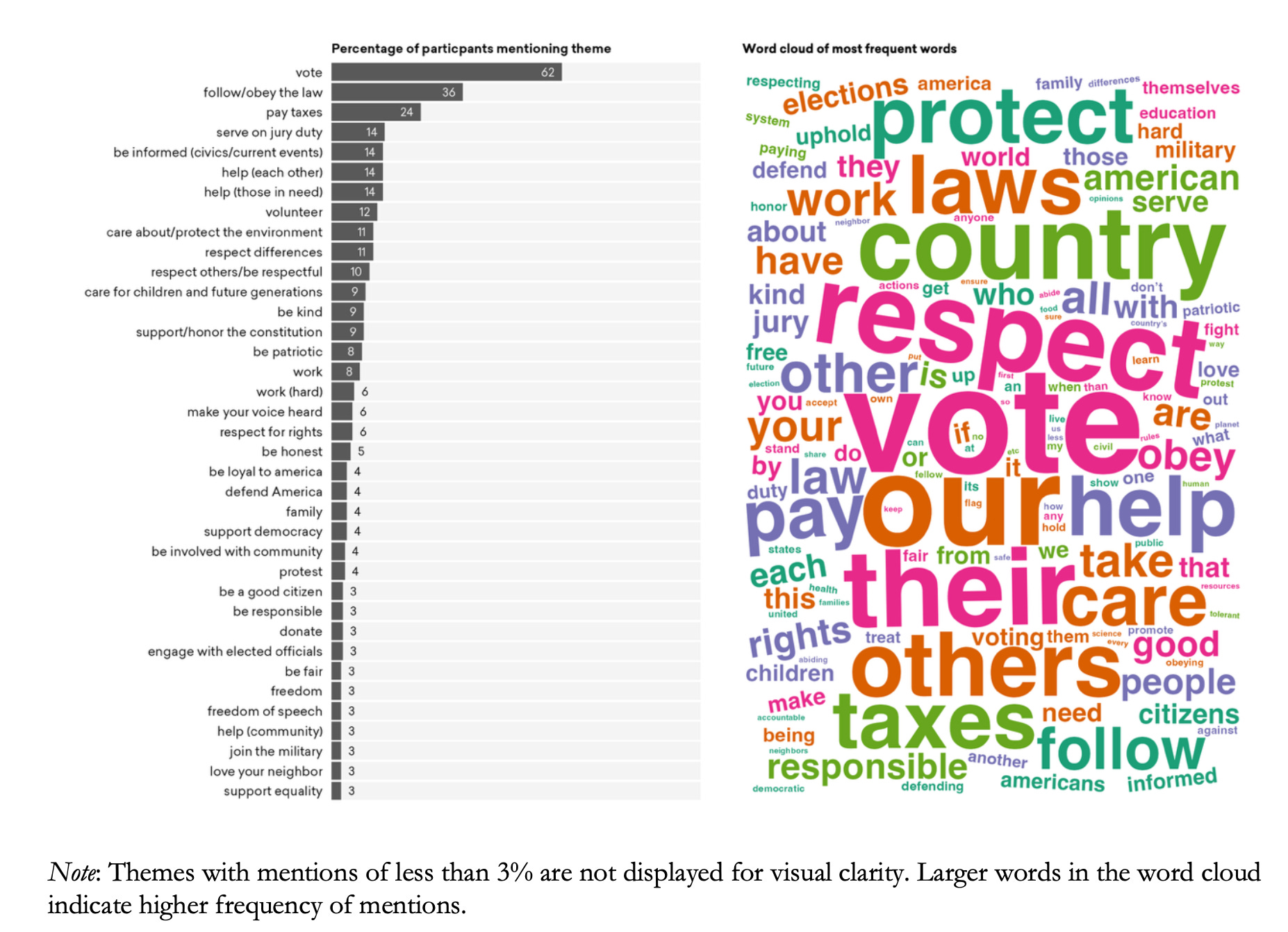
The results hint at a public understanding of civic duty that goes far beyond formal politics. Figure 1 shows both a bar chart of the most common themes and a word cloud of the most frequent words. The top themes reflected what Americans think of as “core duties”—voting (mentioned by 62% of participants), obeying the law (36%), and paying taxes (24%). Notably, though, a large variety of other themes showed up: words like “respect,” “help,” “care,” “community,” and “protect” appear prominently in the word cloud, showing Americans’ understanding of civic responsibility go beyond Civics 101.
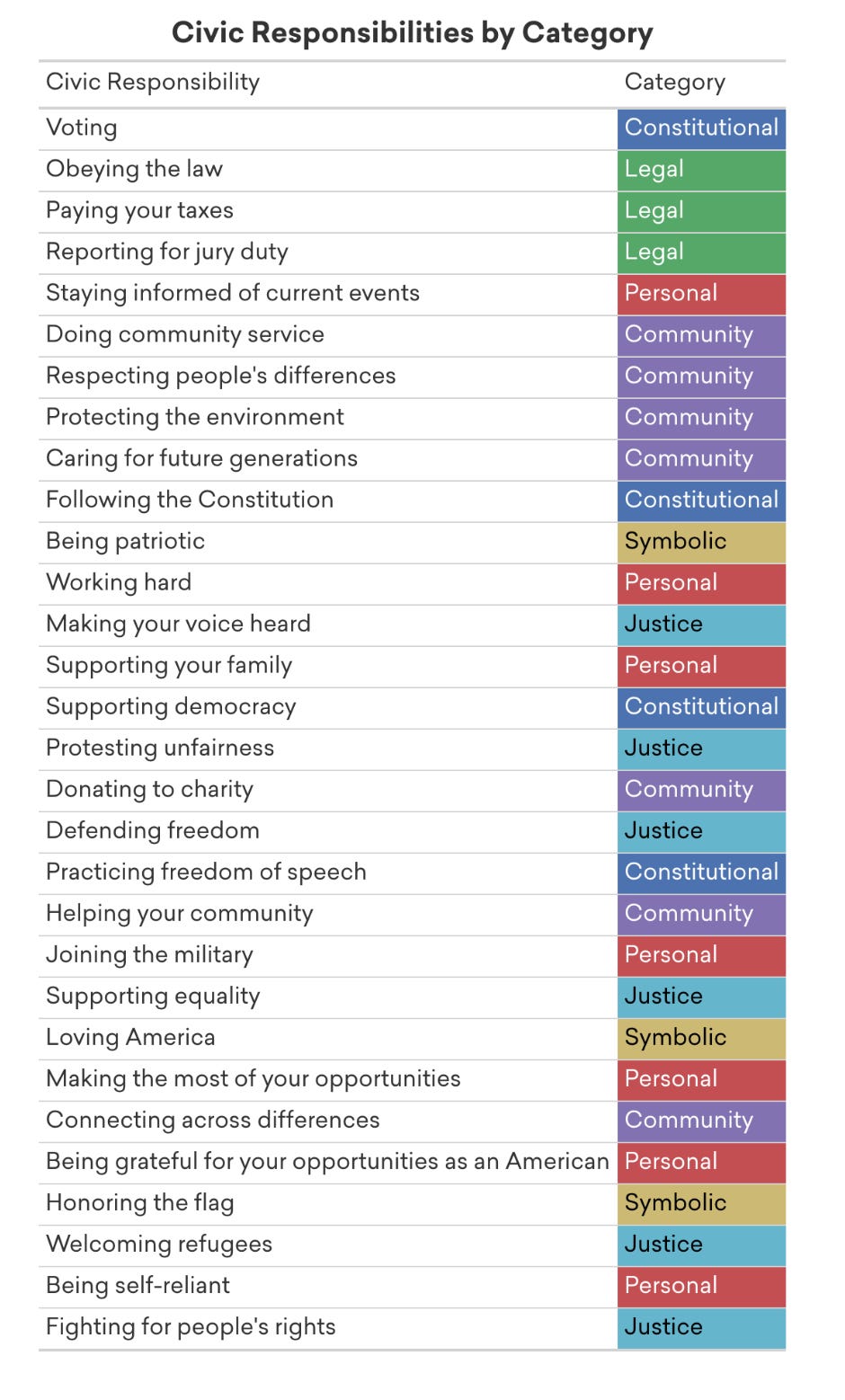
After coding the open-ended responses, we organized the themes into five categories—a working map of how Americans think about civic responsibility:
Legal & Constitutional responsibilities (e.g., voting, obeying the law, paying taxes, following the Constitution, practicing freedom of speech)
Community responsibilities (e.g., helping your community, doing community service, respecting differences, protecting the environment)
Personal responsibilities (e.g., working hard, being self-reliant, supporting your family)
Symbolic responsibilities (e.g., being patriotic, loving America, honoring the flag)
Justice responsibilities (e.g., supporting equality, protesting unfairness, fighting for people’s rights, welcoming refugees)
This categorization became the backbone of Study 2, where we tested how widely each of these responsibilities is endorsed across the country.
Study 1 also asked people to react to a few broader “civic ideas”—statements about whether civic responsibility matters and whether it feels relevant to daily life. The results suggested broad recognition of the importance of civic responsibility.
For example:
93% agreed that “America would be a better place if more people had a sense of civic responsibility.”
92% agreed that “Now more than ever, it is important to honor our civic responsibilities.”
Only 25% agreed that “The idea of civic responsibility has little relevance to my daily life.”
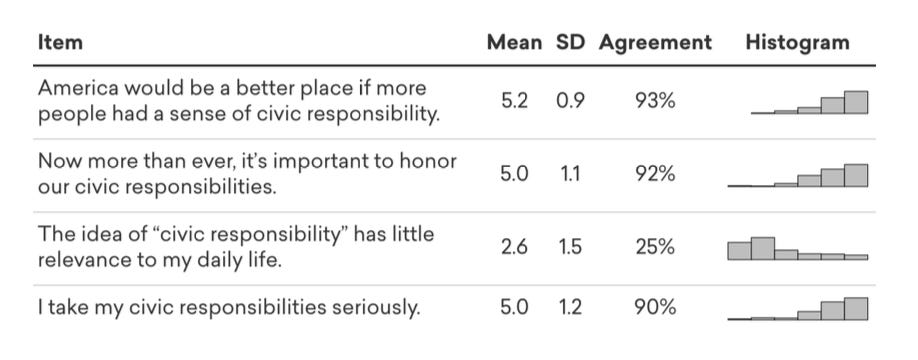
Notably, there were no significant partisan differences on these basic questions. This suggests that there is a shared baseline: most Americans, regardless of political party, believe civic responsibility is real, and it matters.
What we are responsible for, on the other hand, is a different story.
Study 2: Shared and Contested Duties
In Study 2, we surveyed 5,000 U.S. adults in a nationally representative sample. We gave them a list of 30 behaviors (drawn from Study 1) and asked a simple question: Is this a civic responsibility—or not?
Areas of Agreement
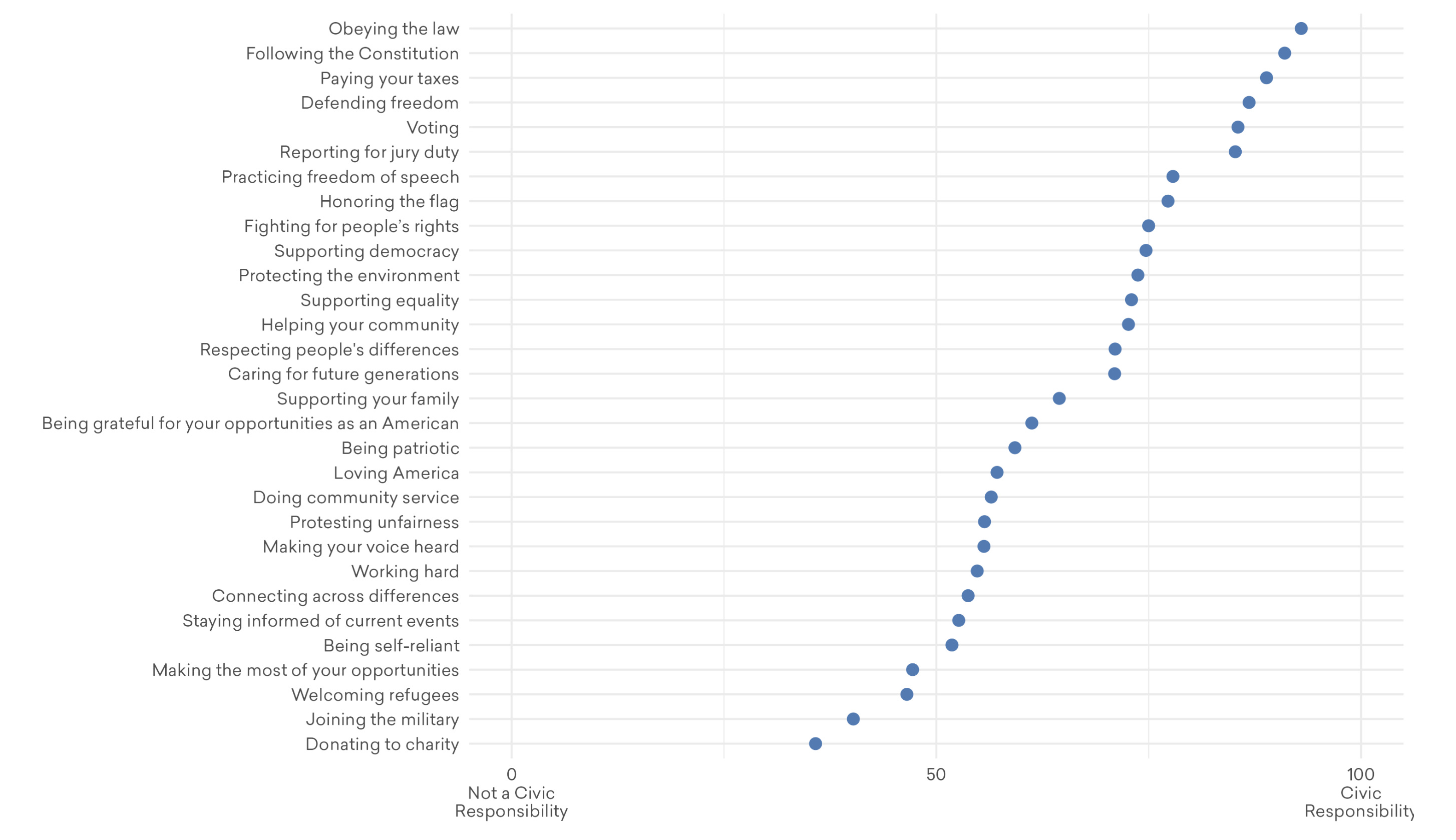
On average Americans identified an average of 20 behaviors as civic responsibilities.
Figure 2 (below) plots each of the 30 behaviors by what percent of Americans consider it a civic responsibility. This figure helps make one of the study’s central findings intuitive: America has a strong shared civic center—but fuzzier boundaries around the edges.
If you overlay Figure 2’s rankings onto the categories in Table 1, you get a pretty clean split:
Legal & constitutional responsibilities are high-consensus.
Obeying the law (93%)
Following the Constitution (91%)
Paying taxes (89%)
Defending freedom (87%)
Voting (86%)
Symbolic and justice responsibilities are more contested.
Loving America (symbolic): 60%
Being patriotic (symbolic): 59%
Honoring the flag (symbolic): 79%
Welcoming refugees (justice): 46%
Protesting unfairness (justice): 55%
Demographic Differences
Next, we explored whether endorsement of these behaviors varies along demographic lines.
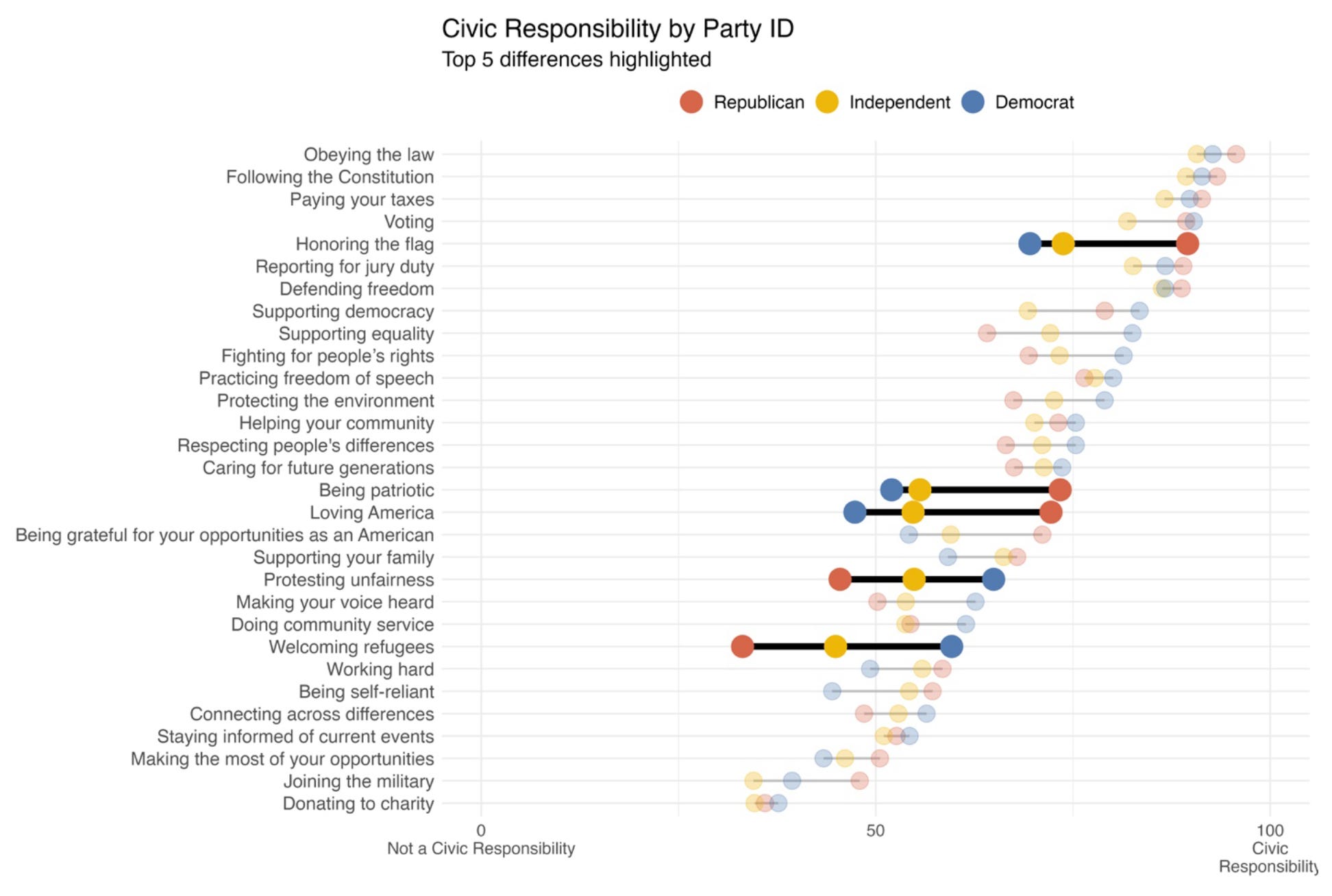
Party Identification
Interestingly, Democrats and Republicans endorse the same number of civic responsibilities on average (around 20) but disagree about which ones matter most.
Republicans are more likely to see symbolic acts as civic duties: being patriotic, loving America, honoring the flag.
Democrats are more likely to treat justice-oriented acts as civic duties: protesting unfairness, welcoming refugees.
This suggests polarization isn’t about who loves the country more, or feels a greater sense of responsibility to it—instead, it’s about different visions of what “good citizenship” looks like.
Generational Differences
Figure 4 shows the same analysis by generation. Again, all generations endorse roughly the same number of responsibilities—but their emphases diverge.
Older Americans are much more likely to endorse symbolic duties:
“Being patriotic” drops from 73% (Silent Generation) to 48% (Gen Z).
Similar patterns show up for loving America (78% → 51%) and honoring the flag (88% → 69%).
Meanwhile, younger Americans are more likely to endorse justice-related responsibilities:
Gen Z is more likely than Baby Boomers to say it’s a civic duty to protest unfairness (64% vs. 48%) and welcome refugees (55% vs. 41%).
They’re also more likely to see caring for future generations as a civic responsibility (78% vs. 66%).
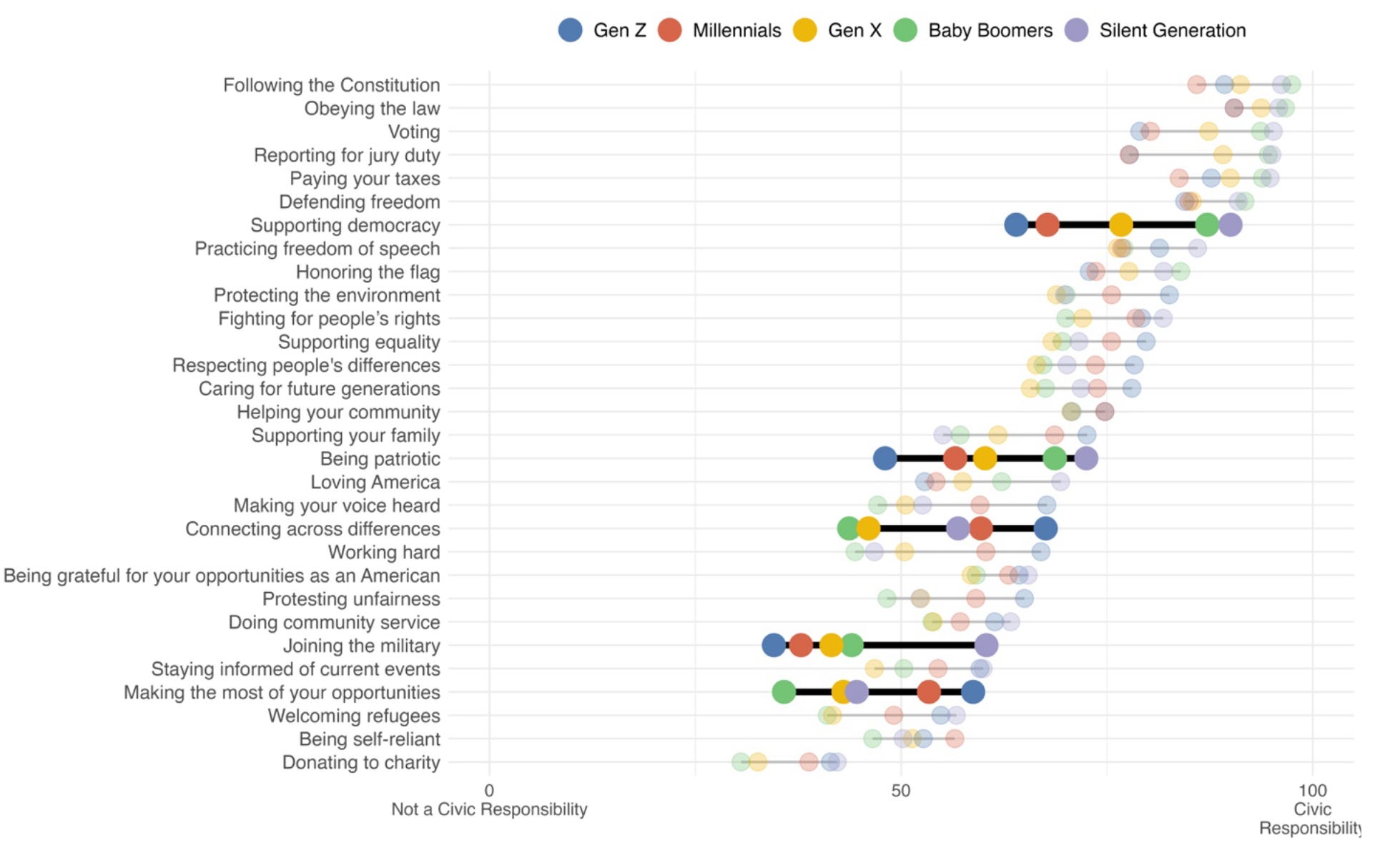
So while there is a generational divide, it’s not a divide in how much people care. It’s more what they care about.
Income Differences
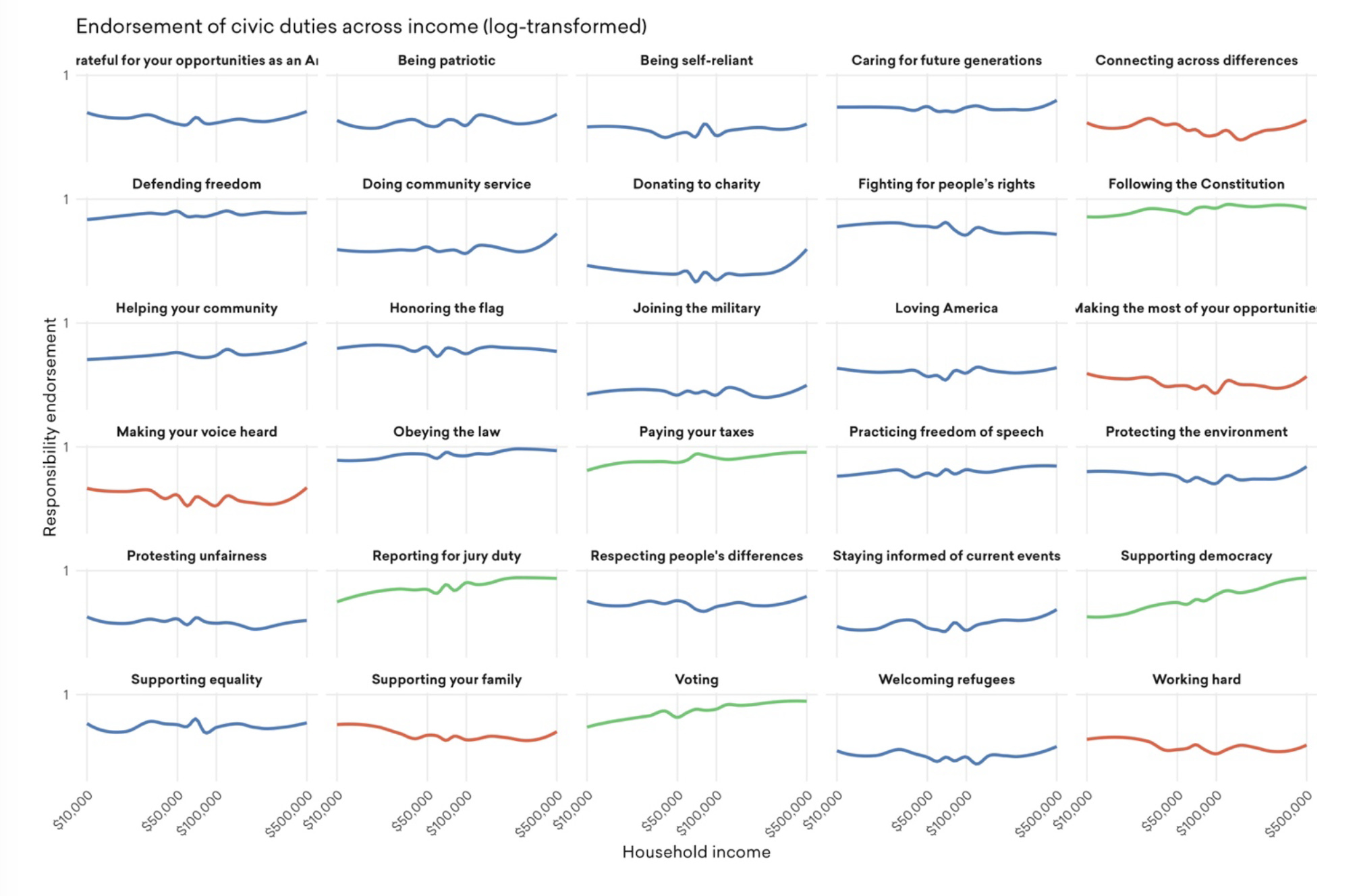
Finally, Figure 5 shows how civic beliefs shift as income rises. As income increases, people become more likely to endorse “legal & constitutional responsibilities” and other democracy-maintaining duties as civic responsibilities—things like:
supporting democracy
voting
jury duty
paying taxes
following the Constitution
But as income decreases, people become more likely to endorse personal and communal responsibilities—things like:
working hard
supporting your family
making the most of opportunities
making your voice heard
connecting across difference
The pattern suggests people facing different economic realities may have different instincts about what it means to contribute. Higher income folks show greater attachment to civic structures and democratic institutions writ large. Lower income folks (who may not feel served by these national institutions) are more focused on communal activities and personal responsibilities.
Two Layers of Citizenship
These findings offer a nuanced portrait of public conceptions of civic responsibility.
We find two “layers” of the way people think about responsibility in public life. The first is a shared core ‒ a bedrock of duties that Americans broadly agree are essential to our democracy. The second is a set of outer, more subjective responsibilities ‒ values that people weigh differently based on their experiences, identities and moral intuitions.
Among these more subjective responsibilities, there are notable partisan differences. But these points of tension are not random. They’re concentrated in two areas:
Symbolic duties (patriotism, national pride, flag-related behaviors)
Justice-oriented duties (protest, welcoming refugees, equality-focused actions)
It would be easy to read these differences as evidence of civic decay. I see something else.
Far from weakening our democracy, this pluralism may be one of its greatest strengths. It suggests that many Americans hold a richer understanding of citizenship than may be assumed—one that allows people to contribute in different but meaningful ways.
Americanness has never been about sameness. From the beginning, this country has depended on people who show up differently, bring different gifts and express commitment in different ways.
As we kick off a year of celebrations for America’s 250th birthday, the challenge is not to force agreement on the one “right” way to be a citizen, but to recommit to the common ground that makes our disagreements survivable. Recognizing that there is value in our different contributions as citizens may be one of the most important civic habits we can practice—almost as important as washing our hands.
Explore Further
We’re really excited about this work and have created a number of ways for you to explore the project further:
🌐 Check out the project website, CivicProfile.us
🧠📊 See how your beliefs about responsibility compare with other Americans by taking the quiz. Share your results in the comments!
📈🖱️ Explore the data for yourself with this interactive data dashboard
📄🔬 Read the scholarly preprint on this project
📰✍️ Read our op-ed in USA Today